The unfinished medium
The work that produced Smalltalk was never only an effort to create a programming language. Its larger ambition was a personal dynamic medium: a computing environment people could explore, understand, reshape, and use to extend their own thinking. Liveness, messaging, reflection, graphics, and user programmability were means toward that end.
That ambition remains compelling. Yet the systems that preserve it most faithfully still carry architectural assumptions formed in a research laboratory: a self-contained image, a largely individual working style, informal protocol knowledge, and weak boundaries between subsystems. Those qualities make an image immediate and malleable, but they also make outside work harder to incorporate, compare, replace, version, and share.
The island problem
A system becomes an island when its most valuable ideas are available only to people willing to inhabit its entire world. Integration with operating systems, networks, contemporary development practice, collaborative work, and specialist tools then becomes an afterthought—a ferry service to the mainland rather than part of the architecture.
System-128 seeks to move beyond that isolation without giving up the qualities that made the island worth visiting. The image becomes a workspace within a larger object universe. Subsystems meet through published protocols. Models can outlive any one tool. Implementations can be replaced, and work created elsewhere can enter the system without first being remade in its image.
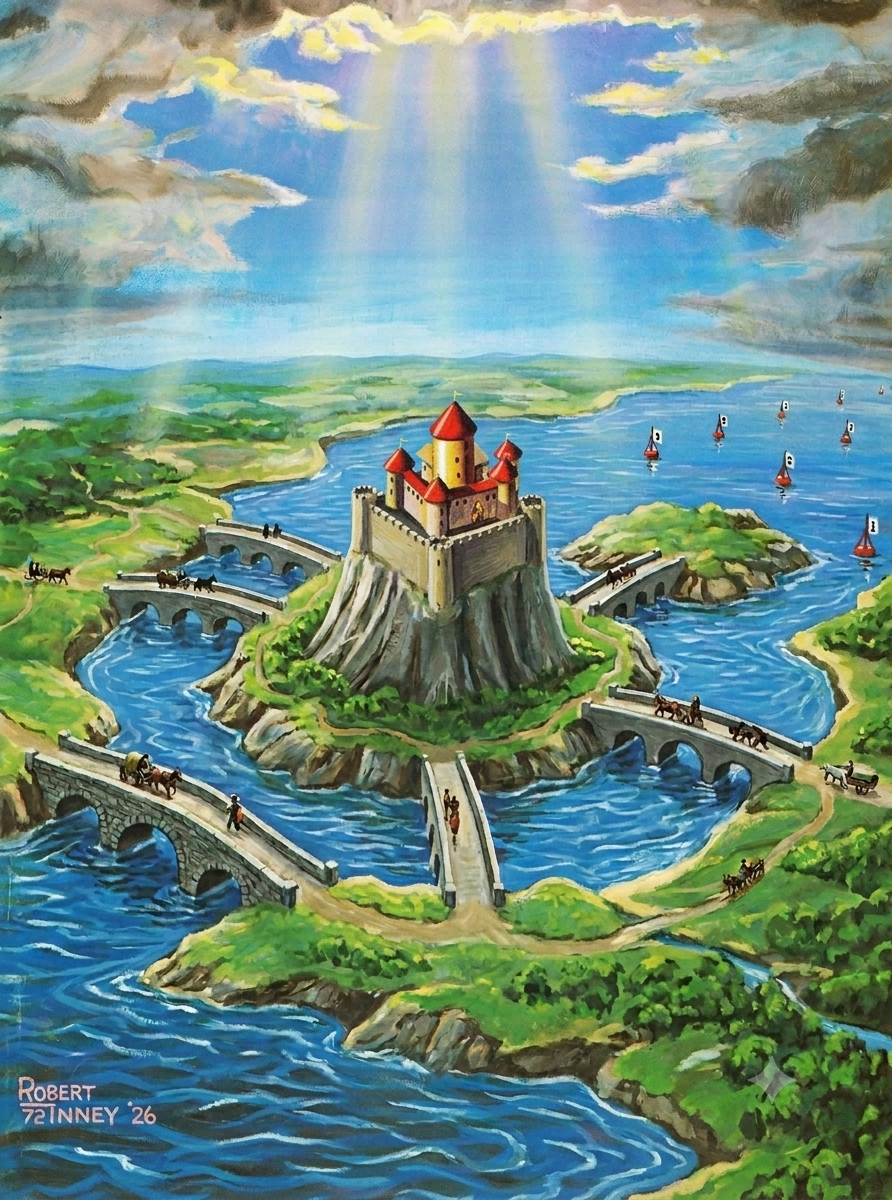
Bridges, not an escape
The castle in Bridges to the Fantastic Kingdom represents the extraordinary body of ideas developed inside an intensive research culture: a live object world, direct manipulation, personal computing, and programming as a form of thought. Its surrounding water represents the separation that can arise when a research environment becomes self-sufficient and difficult to connect with work beyond it.
The bridges are the project’s objective. They stand for explicit, principled connections: protocols for operating systems, storage, networks, devices, development workflows, documents, media, and future research. Traffic crosses in both directions. Ideas created inside the system can travel outward, and new models created elsewhere can enter without surrendering their identity.
Why the name comes last
System names the scope of the work. This is not merely a language or an integrated development environment, but an investigation of the object model, execution environment, persistence, distribution, tools, interaction, and the relationships among them.
The “128” is a date of intended realization, not a version number, word size, or claim of succession. It identifies 2028, one hundred twenty-eight years after 1900, following the historical year-suffix convention of the early Smalltalk systems as an homage.
The project reaches that destination only when a working implementation demonstrates the Constitution’s criteria. The name acknowledges an intellectual influence while asserting no ownership, endorsement, institutional connection, or technical lineage.